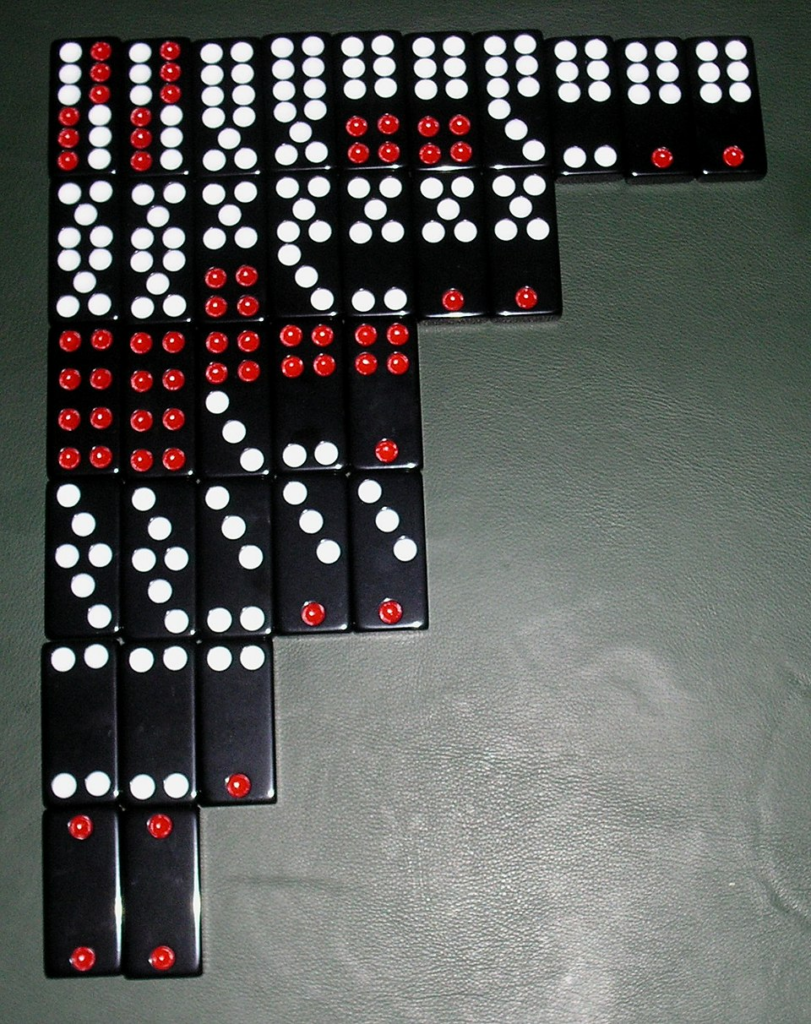
While doing some research to learn more about the dice game of Cee-lo. I stumbled on a paper by Stewart Culin, an American ethnographer, on Chinese games involving dice and dominoes. Scanning through it, I found a section, titled “FORTUNE TELLING WITH DOMINOES” which piqued my interest. However, the section did not go into specifics, so I was left wondering on the remaining instructions for the process.
I could not find any sources on this in English, although I found a few in Chinese. I read a few of them, and will give more detailed instructions of the method mentioned by Culin.
1. Start off with a set of 32 dominoes.
2. Rearrange them face-down, and then line them up in a row
3. Reveal the dominoes
4. Look for patterns in adjacent dominoes, using the following table. Tally up the points each time you see the following occurrence(s):
Unlike
Three adjacent dominoes consisting of 1, 2, 3, 4, 5, and 6 pips (6 points)
Ingeniously Divided
Three adjacent dominoes consisting of four sides with the same number of pips, and the remaining two sides adding up to the pips of the remaining four sides (4 points)
Five Spots
Three adjacent dominoes consisting of five sides with the same number of pips (5 points)
Divided Reciprocally
Three adjacent dominoes with three sides sharing a number of pips, and the other three sides also sharing a number of pips (3 points)
Cavalry
Three adjacent dominoes with sides of 4, 4, 5, 5, 6, 6 (3 points)
Two, Three, Six
Three adjacent dominoes with sides of 2, 2, 3, 3, 6, 6 (3 points)
Ace, Two, Three
Three adjacent dominoes with sides of 1, 1, 2, 2, 3, 3 (3 points)
Corresponding Spots
Two adjacent dominoes that are the same (3 points)
Correctly Satisfied
Three adjacent dominoes, with three sides being the same, and the remaining three sides having a sum greater than or equal to 14 (1 point)
5. After going through all the adjacent sets of dominoes, If the tally is 12 or greater, mark your result down as 上上 (top top). If it’s 10 or 11, mark it down as 上中 (up middle). 8 or 9, 中平 (middle flat). 5, 6, or 7, 中下 (middle down). 4 or below, 下下 (down down).
6. Repeat steps 2 through 5 again two more times, noting down your final result each time.
At this point, I think it’s important to point out that there’s some ambiguity between what the patterns exactly entail, and what the result each final tally should correspond with. For example, the Alone in the Fart blog and the 360 doc website seem to disagree on what calvary (馬軍) means, with the former going with 4, 4, 5, 5, 6, 6, and the latter going with 1, 1, 4, 4, 3, 3. Culin’s report matching the final sum with the result also seems to be pretty inconsistent with the fact that he only offers four possible results (leaving out “up middle”), so I decided to go with the correspondences in the Alone in the Fart blog post.
If you grew up in America and went to a public school, you likely learned how to write the famous five paragraph essay. What is the five paragraph essay? It’s composed of a paragraph for the introduction and your thesis statement, three paragraphs for evidence to support your thesis statement, and finally a paragraph for the conclusion that wraps up the whole essay. This was something that I had to learn how to write in, not only for English classes, but for history classes as well in high school.
A few days ago, I was chatting with a few of my high school friends when the topic of writing education in high school came up. We pretty much all agreed that the essays we were writing on were all of a similar “style.” Our works were usually centered on analysis on what we read, and we had little room to explore other methods of writing, such as story narration or speechwriting. It’s safe to say that I’ve never really had any opportunities to find my own “voice” when writing, and while I never noticed this in high school, it became apparent when I started writing for fun after high school.
A day after this conversation with my high school friends, I stumbled on a separate conversation online on Discord where a public school teacher was critical about the current state of writing education in America. He pointed out that if he told his students that they can write outside of the five paragraph essay framework, he’ll start receiving blank faces.
Honestly, I can’t blame him at all. If you asked me to write outside of such a framework in high school, I’d be confused as well. After all, I don’t recall learning any specific format outside of that; it’s hard for me to think of any opportunity where I had ample time to explore other ways of writing. When you’re a high school student who has to wake up around 6 AM every week day, go to school and come back around 4 PM, and then spend the rest of the evening hustling to get your homework done before you become tired at 12 AM, the last thing that will be in your head is taking some time out of each day to craft your essays to contain your “voice.” I’d rather stick to the standard format so I can get homework done quicker and go to sleep earlier so I don’t have to wake up tomorrow morning barely dragging myself out of bed.
I started wondering if this is anyone’s fault. Obviously, I can’t put this on the teachers, since they had to conform with a set of curricula that their students have to master by the end of the school year. Besides, sticking with the standard format will probably make grading easier, as well as making it more fair for students. After all, I’d reckon a teacher would have a harder time assigning a “fair” score to each paper if the format is completely different for each of them.
At this point, I remembered learning about how in ancient China, civil service examination candidates were sometimes expected to write in a certain format, called the baguwen, which translated into English means eight-legged essay. Unsurprisingly, these essays were composed of eight parts. When I read the Wikipedia article on the baguwen, especially the viewpoints section which described the positive and negative views on such a format, one can hardly be surprised. The positive views were that such a format would have ensured greater fairness and ease when grading exams. The negative views were that the baguwen stifled creativity and might have contributed to the decline of Chinese poetry. Some even go as far as to say that it constrained thinking and might be responsible for China’s “economic backwardness.”
I’m not an expert on Chinese poetry, but I do know that the Tang had famous shi, the Song had ci, and finally the Yuan had qu. Overall, it seems that most of the famous Chinese poetry was written in these eras compared to later dynasties, so there does seem to be some correlation between the adoption of the baguwen and the decline in Chinese poetry. I’m speculating here that writing poetry is a muscle to strengthen, and if candidates spent most of their time writing for a certain format, the poetry muscle would likely atrophy or not develop at all. If you know anything about classical Chinese poetry, I’d be interested in hearing your thoughts on any noticeable changes throughout this era of history.
As to whether this format constrained thinking to the point of contributing to the Chinese decline, and caused the West to overtake it (the Needham Question), I think it might be worth it to ask another question. Rather than the format causing constraints in thinking, what if it was a constraint in thinking that caused the baguwen to be adopted for the examinations, and the tradition stuck for a few hundred years afterwards?
After all, given my current understanding of Chinese history, it seems that China fell behind the West because of its strict conservatism and reluctance to change. After Zheng He set sail for the Pacific in one of the largest fleets of its era, conservative mandarins in the Ming Court thought such an expedition was costly and unnecessary. With attitudes like these, colonization would never come to fruition, and interaction with the outside world became more limited in scope.
In such an environment, it’s no surprise that innovation was frowned upon, and the format of the imperial civil service examinations started to calcify. When the priorities aren’t on recruiting the most creative and innovative students, there is no problem with sticking to a certain format for testing.
What does it mean for us? Why did we go on a long tangent on the baguwen? Rather than just criticizing the five paragraph essay for stifling creativity, we should look at a deeper phenomenon taking place. Perhaps it’s an education system that no longer prioritizes creativity as it used to. The phenomenon of prioritizing efficiency over quality is quite possibly merely a symptom of the current cultural attitude.
There’s one word that I want to use to describe this novel: Sobering.
In The Smiling Proud Wanderer by Jing Yong, we follow the adventures of the main protagonist, Linghu Chong, as he goes from a happy-go-lucky martial arts practitioner to facing the real world where he has to deal with the nasty world of politics and power struggles. Along the way, he has to make many difficult decisions, as he faces conflicts between loyalty, righteousness, and his own self-benefit.
While this book is commonly viewed as a wuxia novel, I consider this work to be a political novel as well. Unlike the rest of Jin Yong’s novels where an explicit time frame is mentioned, this novel does not mention a specific dynasty. This is most likely a conscious decision by Jin Yong, who in the afterward noted that the events in this novel can apply to any dynasty.
The book starts by introducing Lin Pingzhi, a son of the head of the Fuwei Security Service Agency. His family owns the Bixie Swordplay Manual, which makes them a target. One day, the agency gets massacred and his family gets captured by the Mt. Qingcheng Sect, which leads to Lin thinking of ways to avenge his family.
Meanwhile, Linghu Chong saves the nun Yilin from the bandit Tian Boguang. Soon after, Lin Pingzhi gets accepted to be a disciple of Linghu Chong’s master, Yue Buqun, where they soon return to the home base of their sect, Mt. Hua. For reasons that will be made clear when you read it, Linghu Chong gets punished by his master to isolate himself on a section of the mountain, where he later learns skills that were carved into a cave that he finds, as well as learning a technique called Dugu Nine Swords from a very old member of the sect, Feng Qingyang.
One day, Yue Buqun calls on the members of his sect to go on adventure, which causes a series of events that leads to Linghu Chong facing the complexities of the jianghu, the world of martial arts.
Warning: Major spoilers ahead.
As the story progresses, Linghu Chong becomes more aware of the complex world of politics. He realizes that the leader of the Mt. Song Sect, Zuo Lengchan, wants to get the other sects in the Five Mountain Sword School Alliance to submit to him. He eventually realizes his own master that took care of him all these years turns out to be a power-hungry schemer who aims to overthrow Zuo and be the leader of the Five Mountain Sword School Alliance.
Overall, there is an overarching theme of the gray morality of people. Linghu Chong is portrayed as a bit of an alcoholic and gambler who uses coarse language and doesn’t mind associating with people that have a bad reputation, but deep down Linghu Chong has a strong sense of honor to do what is right and is very caring towards the people around him. In contrast, his master is portrayed as a gentleman who carefully selects his words to seem like a morally upright individual, when in fact he is willing to betray everyone around him, even his family, to gain power and get what he wants.
Speaking of Linghu Chong’s relationship with his former master, an important topic of discussion in this novel is loyalty. The code of jianghu dictates that students should do what their master wishes them to do, but we see how the case of Linghu Chong tests the bounds of this “rule.” Even while his master Yue Buqun started doubting him, and even kicked him out, Linghu Chong always tried to remain loyal towards him. In fact, towards the end of the novel, Yue tried to kill him, but even then Linghu Chong tried his best to remain in self-defense rather than being on the offense and killing his former master.
Truth be told, it was a bit hard to read towards the end when Linghu Chong vowed to remain loyal when his own master was literally trying to kill him.
While Linghu Chong has to deal with his former master, he also starts being tangled in the affairs of the Sun Moon Holy Cult, a sect that is known to be evil among the more “orthodox” schools of the jianghu, after he falls in love with Ren Yingying, the daughter of the former leader of the cult, Ren Woxing. He starts realizing that not everyone in the Sun Moon Holy Cult were as evil as they were rumored to be,
Things aren’t as simple for the organizations in the novel as well. The “orthodox” schools in the Five Mountain Sword School Alliance turned out to contain quite a few evil individuals, while the Sun Moon Holy Cult has some pretty good individuals. Jin Yong was really trying to hammer the point that often in politics, it’s rare to come across an organization that is entirely good or bad. We live in a world where many people think that their side, their party, their organization, etc. must be the good guys, while the other side must be the bad guys, when in fact both sides can contain rotten apples. Check out this related tweet I found.
At this point, one might think that as long as a decent person rises to the head of an organization, then everything will be alright. However, the novel seems to suggest this is not the answer as well, as power can lead to moral corruption, judging from the case of Ren Woxing. When Ren Woxing found out that Dongfang Bubai, the man who ousted him from power, started implementing all sorts of rituals and customs into the Sun Moon Holy Cult, he found it ridiculous at first. However, after Ren regained his position, he started going on an ego trip and decided to keep the rituals and customs that Dongfang Bubai introduced prior.
How does Linghu Chong deal with all the complicated political intrigue he had to see and experience? By the end of the novel, we see that he has been fed up with all of this and decided to distance himself from the politics in the jianghu. Instead he chooses to spend his days with his wife, Ren Yingying. This is not unlike many of the thinkers in Chinese history who’ve attained great positions in government, but decided to give it up to live in the mountains or their hometowns where they can be free from the complex web of politics.
In essence, the message from this novel seems to be rather than dealing with the nasty game of politics, it is better just to not play the game at all and instead become a smiling, proud wanderer.
Bazi explained, how it relates to the Chinese zodiac, and much more.
The Four Pillars of Destiny, also known as Bazi (八字), is a Chinese fortune telling technique that attempts to calculate your fate based on the day and time you were born. Your birth chart will consist of four pillars/columns, one for the year, one for the month, one for the day, and one for the time. Each column will have two characters, which makes eight characters in total that will be used for telling your future. To get your bazi, you can use a calculator online.
You have likely heard of the Chinese zodiac, and these concepts are related. In fact, your zodiac animal will be associated with one of the eight characters. For example, if you were born on the year of the rat, this will correspond with 子, which means that one of the characters for your year will be 子.
The top character of each column will be from the set of the heavenly stems (天干), which consist of 甲 (jia), 乙(yi), 丙(bing), 丁(ding), 戊(wu), 己 (ji), 庚 (geng), 辛 (xin), 壬 (ren), 癸 (gui). Each of these elements have an element and a yin/yang associated with them. For example, 甲 is yang wood, while 乙 is yin wood.
The bottom character of each column will be from the set of the earthly branches (地支), which consist of 子 (zi), 丑 (chou), 寅 (yin), 卯 (mao), 辰 (chen), 巳 (si), 午 (wu), 未 (wei), 申 (shen), 酉 (you), 戌 (xu), 亥 (hai). Likewise, each of these elements have an element and a yin/yang associated with them as well. For instance, 子 is yang water, while 丑 is yin earth.
Before proceeding further, I highly suggest familiarizing yourself with the relationships between the wuxing (五行), also known as the five elements, 金 (metal), 木 (wood), 水 (water), 火 (fire), 土 (earth). Place particular focus with the 生 (generating) and 剋 (overcoming) cycles. You can check out the wuxing article on Wikipedia for reference.
Once you have your birth chart ready, you can start doing your analysis. The heavenly stem of your day pillar, commonly referred to as your day master (日主), would represent yourself. Most analyses will be in relation to the day master.
Gods and Spirits
This is probably the most straightforward way to analyze your birth chart. There are many charts online that you can use as reference for finding out which gods and spirits play a role in your chart. There are probably several dozens of them, but the ones I see that are most commonly used are ones like 天乙貴人, 文昌貴人, 驛馬, 華蓋, and 桃花. If any of these are present in your chart, find out how they impact your life. Given my understanding, the gods mentioned in Bazi are not gods in the Western sense. Rather, they are more like energies.
Strength of Your Day Master
If your chart has a bunch of elements that are the same element as your day master or generate your day master, then your day master would be considered strong. If your chart has a bunch of elements that overcome your day master, or if your day master generates or overcomes a lot of elements in your chart, then your day master will be considered weak. Whether your day master is strong or weak can play a factor in what elements can be auspicious for you.
The Ten Gods (十神)
Depending on the polarity and the elements of the other characters in your chart, each character will have a god associated with it depending on your day master. The presence of these “gods” can give insights to a person’s personality, such as their creativity and proclivity for wealth. There are different interactions with some of these “gods,” so aspects can be magnified or diminished depending on other “gods” that are present in the chart. Knowing what each of the ten gods represent and how they affect each other is crucial for analyzing a bazi chart, so pay extra attention to studying this.
A is day master and B is the character
Different Polarity
Same Polarity
B overcomes A
正官 (Direct Officer)
七殺 (Seven Killings)
B generates A
正印 (Direct Resource)
偏印 (Indirect Resource)
A, B are same elements
劫財 (Rob Wealth)
比肩 (Friend)
A generates B
傷官 (Hurting Officer)
食神 (Eating God)
A overcomes B
正財 (Direct Wealth)
偏財 (Indirect Wealth)
Chart for the Ten Gods
To illustrate how the “gods” interact with each other. I’ll give a brief example. For a man whose day master is metal, he might generate a Hurting Officer, which is also responsible for creativity. Think of a Hurting Officer as someone who’s impulsive in personality and lacks a filter. He might spout the most unique ideas you’ve ever heard of, but at the same time his lack of filter can also cause him to say things that inadvertently hurt those around him. In this case, our hurting officer has an element of water, and water in turn can generate wood, which is the man’s wealth element, signaling how creativity can be channeled for generating wealth.
However, the Hurting Officer (the impulsive element), which is water in this case, might be overcome by the Direct Resource, which is earth in this case. The Direct Resource can symbolize logical and conservative thinking, indicating that over-analyzing a problem can overcome and kill our creative urges that we have.
If you can read Classical Chinese, check out 淵海子平, where Xu Ziping goes in detail explaining what each of the gods represent and their interactions with each other.
Favorable and Unfavorable Elements
Once you understand a chart well enough, you will be able to tell which elements would be good for a chart and which elements would be unfavorable for a chart. For example, water might be a favorable element for someone with a weak wood day master, because water helps generate wood. Someone whose favorable element is water might do well in the north, or finding a career that is associated with water, such as working on a ship.
Keep in mind that this is just an example, and someone with a weak wood day master might have a favorable element that isn’t water. Knowing your favorable element can help you decide between two choices such as where to live and what job to take.
Luck Pillars
Throughout your life, there will likely be ups and downs. How does the Bazi system account for this? There is a luck pillar (大運) for every 10 years of your life, as well as a 流年 for every year of your life. You can combine these with your birth chart and analyze the relationships with each other to find out your fortune for different phases of your life.
Combinations and Clashes
Sometimes, there will be characters that can combine, such as 甲 and 己, into another stronger element. Other times, there can be characters that can clash with each other, such as 子 and 午. As a result, this can impact the effects of the “gods” mentioned in previous sections.
Special Structures
In rare cases, your chart might be built in a certain way that is special, such as all four of your heavenly stems being a certain character or a day master that is abnormally strong or weak. In exceptional cases like these, the classic texts are there to discuss how these special cases can affect the individual.
After the Basics
Once you’ve grasped the fundamentals of the previous sections, you can start practicing it, by comparing the life experiences of an individual with their birth chart. However, I would still heavily discourage fortune telling at this stage, because what you say about their birth chart can have unintended consequences for the person you are practicing it on. It is important to emphasize that at the end of the day, the Four PIllars of Destiny are merely a tool that you can use to help you or others make decisions. You should not let this fully replace other steps of the decision process and let it fully control you.
Learning bazi will allow you to be more acquainted with Chinese metaphysics, and will help speed up the process of learning other related concepts such as feng shui, divination, and traditional Chinese medicine.
My path to learning Classical Chinese, also known as literary Chinese, is one that has been going on for several years. Growing up going to Chinese school every week, I’d say I can read the average Chinese book published nowadays without any major problems. Reading books that are written in Classical Chinese, however, is a whole other matter.
My interests in Classical Chinese started from learning about the Four PIllars of Destiny, a traditional Chinese fate calculation technique. However, past a certain point, I realized that many of the classics teaching these methods were written several hundred years ago, with the original book on this topic stretching back all the way to the Song Dynasty. Needless to say, if I wanted to read and understand the text in its original form, I had to learn Classical Chinese.
Of course, there are other reasons to learn Classical Chinese as well. A lot of Chinese philosophical texts were written in literary Chinese. If you are interested in this, I have an article on learning Chinese philosophy. Historical texts such as The Records of the Grand Historian were also written in it. If you want to read the primary sources, you will have to learn it. This might sound cliché, but learning it literally opens up doors if you are interested in Chinese history and philosophy, as you no longer have to depend on modern translations.
How do I learn Classical Chinese though? Through my research there seems to be two ways. Either continuously grinding through progressively older texts, trying to figure out the older grammatical structure and common vocabulary that occurs in the texts, or picking up a textbook on that subject. I later settled on the latter option, and went searching for a textbook.
Considering I live in the West where Chinese books are not easy to find, I eventually settled on a textbook that taught Classical Chinese in English. The textbook was titled An Introduction to Literary Chinese by Michael A. Fuller. If I were able to access a textbook that taught the subject in Chinese, that would have been better, but alas, circumstances did not permit me to do that, so I had to go with the next best option of a textbook written in English.
I then proceeded to read through An Introduction to Literary Chinese, with me rereading some sections several times. While I admit I do not fully understand everything from the book, I’d say I picked up quite a bit of the basics, particularly the grammatical structure and the vocabulary employed in Classical Chinese.
Once I’ve read a large portion of that book, I was able to trudge through Sun Tzu’s Art of War with a dictionary for more obscure characters. There are dictionaries for Classical Chinese specifically, because certain characters can have different definitions in Classical Chinese vs Modern Chinese. For example, the character 走 means “run” in Classical Chinese, but “walk” in Modern Chinese. Interestingly, Japanese seems to have preserved the older definition (“run”) of this character. There is a pretty famous dictionary by Wang Li, a Chinese linguist, which I find helpful from time to time.
By this point, if you pick up the original version of Romance of the Three Kingdoms, you should be able to understand a decent portion of it. After all, it was written in a style that tilts more vernacular mixed with some literary Chinese elements within it. Strange Tales from a Chinese Studio, by Pu Songling, however, is still a struggle for me to get through. Hopefully in the future as I improve on my Classical Chinese I will be able to understand all of it.
I’m still learning Classical Chinese, and so this will be a post that I will continuously update in the future as I progress on this journey. Do you have any tips and suggestions? If so, feel free to share in the comments.
How to learn Chinese philosophy? This seems like a daunting task at first glance. However, it need not be so difficult if you have a good approach to learning it. I will give some recommendations and provide some of my own experiences on how I approached learning Chinese philosophy that I hope will be helpful to you on your path.
1. Recognize that Chinese philosophy is not composed of one school. Rather, it is composed of many different schools. The most common schools are Confucianism and Taoism. Less obscure schools like Mohism and the School of Names are fascinating to learn about as well, although not as influential. Later, Buddhism spread into China from India, which Chinese society embraced as well. There is the notion of the Three Teachings in Chinese philosophy, where Confucianism, Taoism, and Buddhism are harmonized together and each are practiced to a certain degree by many Chinese worldwide.
2. Start finding a book that has a brief overview of all the different schools of Chinese philosophy. When I was in college, I found a book at the college East Asian library called The Chinese Mind by Wang Gung-hsing who spent several pages for each famous philosopher in Chinese history. While this book really helped me grasp the basics, I do realize that this book is probably hard to find outside of an academic setting. In the likely case you cannot find a copy of The Chinese Mind, you can try going with A Short History of Chinese Philosophy by Feng Yu-lan, which is also a very good comprehensive review of famous Chinese philosophers.
3. By the time you are done reading A Short History of Chinese Philosophy, you will likely have a good overview on all the major Chinese schools of thought. You probably also have a school that you find fascinating and want to read more about. In that case, you can try reading the primary texts of the school you are interested in. At this stage, if you pick up a text like the Tao Te Ching or I Ching, it will probably be hard to understand the majority of what these texts are talking about. Fret not, this is normal. Even most Chinese do not fully understand these texts the first time they read them.
4. You will likely have to find a commentary to start understanding more of these primary texts. Commentaries can provide helpful context and analysis that you might not get from directly reading the primary text. Different commentators will likely approach the text in different ways, so before reading a commentary, do some research on the commentator beforehand so you can expect any biases that may be present. There are a lot of commentaries on Chinese thought out there, and there can be modern commentaries on these commentaries as well. For example, I am currently reading a modern commentary on an older commentary of the Cantongqi, an important text on Chinese alchemy.
5. Read and learn more about Chinese history and culture. Doing so allows you to understand the contexts different philosophies arose from, as well as how Chinese philosophical concepts are applied to everyday Chinese life, such as yin-yang, five elements, etc. Rather than treating Chinese philosophy as purely an object of study, find out ways you can incorporate some of the teachings in your day-to-day life. Doing so will help you feel and understand some of the concepts better.
For example, you might often read about the concept of wu wei (inaction) when reading Taoist texts. This does not mean that you can slouch on your couch or sleep on your bed all day and not do anything productive. I admit I’m still in the process of fully understanding what wu wei is, but I think it’s one of those concepts you will comprehend from experiencing it in your life, rather than just reading about it and taking the meaning of the term literally.
6. Sooner or later, you will likely end up in a xuanxue rabbithole. Xuanxue is a bit like Chinese metaphysics/mysticism/spiritualism, and is related to concepts such as Feng Shui and the Chinese zodiac. This gets into more superstition territory, so your interest in it will likely depend on how superstitious you are. These topics are usually heavily inspired by concepts from the School of Naturalists, such as yin-yang and the five elements. If you are interested in a further elaboration of xuanxue, I can write another blog post on a guide to this topic.
7. Start learning more about the broader scope of Asian history and culture as well. This allows you to see how different cultures reacted to different schools of thought. For example, when Buddhism spread from India to China, there are Chinese influences to Buddhism that cause there to be some differences from Indian Buddhism. Then, when Buddhism spread from China to Korea to Japan, there were interesting developments that occurred in Japan that caused it to be a bit different from the Buddhism practiced in China.
8. Even if you have a favorite Chinese philosophy at this point, don’t forget to branch out as well. Different schools of thought have influenced each other throughout the history of China. Some Buddhists read Taoist texts, and some Taoists read Buddhist texts. Even though the Neo-Confucians were often critical of Buddhism and Taoism, they nevertheless took inspiration from these two schools of thought. Other schools of thought have probably played a significant role in the development of your favorite school of philosophy as well.
9. Somewhere down the line, it is worth it to start learning Chinese and eventually Classical Chinese. This will be a very complex task, but it will greatly aid in comprehending these texts, since translation can only help so much. For example, the character 道 can have numerous definitions, not only meaning “the way” (the English term that is commonly used when translating the Tao Te Ching). Learning Classical Chinese also allows you to appreciate the structure of the texts more. In the future I might write an article on my (ongoing) path to learn Classical Chinese.
10. Realize that learning Chinese philosophy is a lifelong activity. You might end up reading the same text multiple times, each time at a different stage of your life, where you will gain newer insights that have not occurred to you before.
So let’s say you finally grabbed yourself a copy of the I Ching. You open up and realize that it’s full of hexagrams with descriptions tied to each of them. Then how do you consult it? Lucky for you, there are all kinds of ways to consult it.
I am sure that if you take a look at the steps, you will find that it is pretty time consuming. After all, you literally have to construct each line of a hexagram at a time. Then, what do you do if you do not want to use the traditional yarrow stalk method?
There is a simplified method for consulting the I Ching that uses yarrow stalks as well. This method has been known in Japan since the 18th century. My research led me to this book: https://dl.ndl.go.jp/pid/760010/1/2 by Arai Hakuga. This method was later used by Takashima Kaemon, also from Japan, for his work Takashima Ekidan, which is a compilation of case studies of Takashima consulting the I Ching, for numerous uses, stretching from business to politics. If you are curious for an English translation of this method, check out this link: https://en.wikibooks.org/wiki/I_Ching/The_Modified_Yarrow_Stalk_Method
This method is faster than the previous one. Instead of constructing each individual line at a time, this method allows us to construct three lines at a time. However, there is an extra step to determine the changing line for the hexagram that the first method doesn’t require. This method also comes with the caveat that there can be only one changing line per hexagram, while the former method allows for multiple changing lines in a single hexagram.
What if you don’t have any yarrow stalks? Can you still consult the I Ching? Of course! There are other ways as well, such as using a series of coin flips to build up your hexagram. Take out your wallet, pick three coins, shake it around, and reveal it. For each head you see, add 3. For each tail you see, add 2. If your total is 6, then you have a changing yin. If your total is 7, you have a yang. If your total is 8, you have a yin, and if your total is 9, you have a changing yang. Repeat this 5 times for the remaining lines to make a hexagram.
That being said, there is an alternative viewpoint which assigns the value of 2 to heads and the value of 3 to tails, and uses the total values as above. Which method is more accurate, I do not know. Feel free to experiment with both techniques and let me know in the comments below.
What if you do not have any coins? Fret not, there are other techniques as well. In fact, in the Chinese book 梅花易數 (Mei Hua Yi Shu), also known as Plum Blossom Numerology, other methods are listed, that use whatever is around you. You can use the current date, you can use the number of strokes in a name, and you can even rely on the number of knocks on your door to come up with a hexagram (this is an actual example in the book) to come up with two or three numbers that you can use to set up a hexagram for the I Ching.
How does this work?
Let’s say someone gives you three numbers, 26, 75, and 22. We take the first number, divide it by 8, and take the remainder. For the math and computer science nerds out there, this is the modulo function. So if you take 26 and divide by 8, you will get 3 with a remainder of 2. Refer to the chart below to get the upper trigram for our hexagram.
Remainder
Trigram
Character
0
☷
坤 (kun)
1
☰
乾 (qian)
2
☱
兌 (dui)
3
☲
離 (li)
4
☳
震 (zhen)
5
☴
巽 (xun)
6
☵
坎 (kan)
7
☶
艮 (gen)
This tells us that our upper trigram will be ☱. Repeat the same for the second number. 75 modulo 8 is 3, which tells us that our bottom trigram will be ☲. We combine ☱ and ☲ together to get ䷰, which is 革 (skinning).
To get the changing line for our hexagram, we take the third number, 22, and modulo 6 it. This gets us 4, which means our changing hexagram would be the 4th line from the bottom. You can then look up in your copy of the I Ching or online to see what the 4th line for the skinning hexagram represents.
What if you only have two numbers? How will you get the third number for determining the changing line? Fret not. You can just add up the first two numbers to obtain the third number.
What if you lost your copy of the I Ching? Can you still get a rough idea of whether your hexagram and changing line is auspicious or inauspicious? Yes. The Mei Hua Yi Shu covers a method to do that, involving the interaction of the five elements. Check this out here: Plum Blossom Numerology (Meihua Yishu).
In short, wuxia is a Chinese genre that is focused on martial arts. This is evident from the Chinese characters for wuxia, which are 武俠. The first character, 武, means martial, while the second character, 俠, means hero. However, there is much more to wuxia than simply Chinese martial arts and tales of heroism. There are usually themes of loyalty, brotherhood, romance, and more present in the novels as well.
What is the difference between wuxia and xianxia?
Let us contrast the Chinese characters for wuxia, 武俠, with the Chinese characters for xianxia, 仙俠. While the second character, 俠, remains the same, the first character, 仙, is different and harder to translate. 仙 is a type of mythical being that is commonly translated as “immortal,” and they usually possess mythical qualities. Unsurprisingly, xianxia would have more tales involving supernatural abilities compared to wuxia, which is more grounded in reality. As an example, while a xianxia character would have the ability to fly long distances in an instant, a wuxia character would utilize qinggong and maybe leap across trees and roofs, but not literally fly into the air.
Who are some famous wuxia authors?
I’m not sure who are the most famous wuxia authors nowadays, but among the classic ones, the most well-known ones are Jin Yong, Gu Long, and Liang Yusheng. Among the three, Jin Yong is undoubtedly the most famous one.
Who is Jin Yong, and how famous is he?
Jin Yong is an author who grew up in Haining, China, and later moved to Hong Kong, where he started writing wuxia for his newspaper. He is very famous in Chinese-speaking countries. Go talk to any stranger in a Chinese-speaking country, and it’s almost certain that he or she has heard of him. In fact, there are constantly new remakes being made based on his novels. I heard Jin Yong was also pretty famous in Vietnam, and according to the epilogue of The Smiling, Proud Wanderer, at one point members of the South Vietnamese National Assembly would hurl around names of the evil characters in the novel as insults toward other members.
What are the best novels by Jin Yong?
While his Condors trilogy is probably the most famous one, the Chinese internet seems to agree that his three works with the most literary value are The Smiling, Proud Wanderer, Demi-gods and Semi-devils, and The Deer and the Cauldron. Jin Yong himself was said to have said that the longer the novel, the better he thought it was, and the later he wrote the novel, the better it was. This leaves the three novels that I mentioned earlier.
Where can I read wuxia?
If you can read Chinese, then it will be fairly easy for you to find the original versions. However, if you want to read them in translation in English, things will probably be a bit harder. If you want to read more recent wuxia novels, you will likely have to make do with a time lag while the most recent update gets translated from Chinese to English. For older novels from authors like Jin Yong, not everything has been officially translated to English yet, so you might have to rely on unofficial translations from websites such as WuxiaSociety.
How much Chinese culture and history should I know before reading wuxia?
You do not need to know a lot in order to enjoy it. However, knowing more about Chinese culture and history is certainly a plus, because it will give you context that will aid in understanding the novel. Before you read one, try looking up the historical background associated with the setting. Trust me, knowing that would help you gain a finer appreciation of the work.
In the middle of a novel, you will likely be tempted to do some research on parts of the culture. Feel free to use Wikipedia or watch videos on Youtube to learn more. Before you realize it, you will start having a rudimentary knowledge of Chinese history. Through reading wuxia, my friend from Pakistan at this stage probably knows more about random Chinese historical figures than most of my Chinese American friends.
Why are wuxia novels so long?
Sooner or later, once you start picking up a novel, you will realize that they are long. Really long. Jin Yong used to be a journalist who started a newspaper in Hong Kong, so he would write installments of around 10,000 characters each day in order to attract people to read them and get hooked on what happens next so they would buy more copies in the future. As a result, some of his novels like the The Deer and the Cauldron were published in installments every day for almost three years.
Nowadays, modern wuxia writers are paid by the character, so the more characters they write, the more they earn. As a result, there is direct incentive for them to write more “filler” chapters. I heard some web novels written in China nowadays can stretch for more than a thousand chapters if they are popular.
Why should you read wuxia?
There’s a lot of content in wuxia, including epic fights, fast action, intricate plot lines, and more. I’ve also written about how we can take lessons from sword stances mentioned in the novels for everyday life. You can also learn quite a bit about traditional Chinese thoughts and values from reading this genre, as well as various sections of Chinese history. You might feel inspired to start reading up on Chinese history afterwards, which can be just as interesting. Last but not least, reading wuxia is fun!
If you want a more in-depth post of what I have to say about this genre, please read my thoughts on wuxia.
If you’re reading this article, I assume that you already know what wuxia is. If you don’t, check out my article that answers basic questions on wuxia.
When my uncle and my father recommended I take a look at some of the classic wuxia novels by Jin Yong, I’ll have to admit I was pretty skeptical initially. However, I know they didn’t recommend wuxia for no good reason, so I resorted to doing some research online.
The common consensus is that the best wuxia novels by Jin Yong, in no particular order, are The Smiling, Proud Wanderer, Demi-Gods and Semi-Devils, and The Deer and the Cauldron. Among the three, The Smiling, Proud Wanderer was the shortest, being composed of four volumes while the other two have five volumes, so I decided to start with this. My research also led me to finding out that the top wuxia authors are Jin Yong, Gu Long, and Liang Yusheng, but I’ll have to put the latter two on hold while I start with Jin Yong.
I’ll be honest here, before I read my first wuxia novel, I did not have high expectations for the genre. I’ve seen too many memes and jokes online of wuxia protagonists being some OP character who cultivated for years in the mountains and eventually developed the ability to instantly kill his opponent with one strike. He later gets into fights with random people he meets in the “jianghu,” all because someone looked at him the wrong way or said a single sentence wrong that the protagonist took offense to. Repeat this every chapter, change some names of who he’s fighting, and boom, you have a wuxia novel that for some reason thousands of readers flock to every day or week to check for the latest updates.
Admittedly, it took me a few months for me to get through my first wuxia novel, which I read in Chinese. Not necessarily out of boredom, but because I had to get used to the vocabulary for the first few chapters, which were sometimes pretty literary. However, around halfway through the first volume, I started picking up pace and was able to thoroughly enjoy the story without unknown characters obstructing the experience. I was able to finish the final volume within a few days, while the first volume took me a month or two of on and off reading.
I’m glad that my previous conceptions of wuxia were thoroughly debunked by reading a novel by Jin Yong. Sure, you have a protagonist that manages to learn a set of powerful sword stances from a reclusive hermit in the mountains. Every other chapter, you have a fight that gets described in vivid detail by the author for several pages. However, I’ve come to realize that there are much more to wuxia novels than simple fighting scenes. Between the training and fighting arcs, you have rich discussions on traditional Chinese culture, including history, literature, philosophy, and in one scene in The Smiling, Proud Wanderer, the type of wine vessels that should be used when drinking different types of wine.
In fact, past a certain point, I realized that wuxia is merely a vehicle for Jin Yong to convey his thoughts and commentary on Chinese thoughts, values, and politics. Few people would likely want to read an essay that solely focuses on traditional Chinese ethics, but when you write an enchanting story where a protagonist has to struggle between deciding the correct ethical choice among several options, then you have a reader who starts contemplating these questions. In this sense, Jin Yong is not only a writer, but a teacher as well. For a further elaboration on how Jin Yong can teach us something about everyday life, check out my article on what the Dugu Nine Swords can tell us about specific knowledge.
Eventually, I started wondering: A lot of these classic wuxia authors lived decades ago, far away from the West. How relevant would their works be in the future? Would wuxia grow popular in the West?
As for the first question, I think the works of authors like Jin Yong would always have a certain degree of popularity, just like how J. R. R. Tolkien is with his The Lord of the Rings series. It might not be like late 20th century China where every other person on the street has read one of his novels before and can make numerous references to characters and plots in the books, but I’m sure people would have at least heard of his name and know a few of his books. After all, every year or so there’s a new remake of one of Jin Yong’s novels. Perhaps his works would even appear in Chinese textbooks in the future one day.
As for the second question, my answer will be less straightforward. Wuxia draws heavily from Chinese culture, and many of the characters base their decisions on a code of ethics that will sound foreign to a Western reader. Wuxia also commonly references parts of Chinese history that would be unfamiliar to those without a background in the subject. As a result, there are some obstacles present that might slow down the growth of wuxia in the West.
However, in recent years, Japanese media such as anime and manga have been flourishing, and Korean media such as K-pop and K-dramas have started growing in popularity as well. Chinese novels such as The Three-Body Problem by Liu Cixin have become bestsellers as well. I am optimistic that more and more people each day will find out what wuxia is, some of whom will start picking up books of the genre as well. Perhaps through reading wuxia, more and more people will start being interested in Chinese history and traditional Chinese thought.
The world of wuxia is a fascinating one. By reading a wuxia novel you are opening yourself to a completely different world from day-to-day life. Why not start reading now, and be amazed by what the genre has to offer?
What a poker game, a sword fighting technique in Jin Yong’s wuxia novels, and a wheelmaker in Zhuangzi can teach us about specific knowledge.
You’re playing a game such as poker, and you have just bluffed your small hand. Your goal by bluffing is to scare all the other players into folding and quitting their hand. Who has an edge in winning this round? The fellow who just learned the rules of poker earlier that day and for, or someone who had a mentor teaching him poker, and reads books studying poker in his free time?
At first glance, it seems like the player who puts effort into studying poker will be more likely to call the bluff and win the round. After all, more knowledge is always a good thing, right? However, upon closer inspection, it might be the player who has just learned poker that very day who will be the likely winner of that round. Why is that?
The more experienced player who studies poker would probably be more cautious. When you bluff, he remembers his poker training, crunches the odds in his head, and speculates that there’s a high chance you have a powerful hand. As a result, he decides this is too risky and decides to fold. You win the pot.
On the other hand, the novice player who just learned poker would have no idea about the rankings of the cards. He’ll mistakenly think his hand is very powerful when it’s nothing more than a small hand. When you decide to bluff, he thinks his hand is powerful and can beat you, and once the cards are revealed, he ends up winning the pot.
A few months ago I was reading about a successful Indonesian businessman by the name of Bob Sadino who pioneered the concept of “stupid learning.” While a “stupid” person might start a business as soon as an idea pops into his head, someone else who has more education might start second-guessing himself and never end up establishing a business.
By now, we can see that just because one is more “educated” in the conventional sense does not mean he will necessarily be at an advantage. But hey, you might be wondering, this doesn’t seem right. After all, what is the point of learning then? If the person who has less knowledge ends up being at an advantage, then why find a teacher, why read books, why learn?
In short, the point of learning isn’t to necessarily learn the fixed facts and steps for a topic. Instead, the importance of learning is to arrive at the essence of the subject matter.
In Jin Yong’s wuxia novel Smiling, Proud Wanderer, Feng Qingyang explains to his student Linghu Chong that there are two types of people that are unpredictable when engaging in swordplay. Those who have never learned it, and those who are so advanced that they have already grasped the essence of swordplay and “forgot” the moves.
Who’s the most predictable in swordplay? The intermediate student who has already learned several sets of moves from his master.
Who will end up winning a sword fight though? The master who already “forgot” his moves and is no longer constrained by fixed sequences of moves.
At this point, I do want to mention that to arrive at such a level, one will likely have to go through the phase of learning fixed sequences of moves beforehand, before he can fully grasp the essence. However, in the novel, we can see that not everyone will eventually be able to get the “essence” of sword fighting. While most characters in the novel are pros at sword fighting, the characters that end up grasping the “essence” and come up with their own techniques on the spot while fighting are few and far between. After all, words are not enough to describe the “essence.” One has to feel it through experience.
We can see a further elaboration of this concept in the Zhuangzi. Duke Huan, who was in the middle of reading a book on statecraft, got interrupted by his wheelmaker, Bian, who explained to him that the book the duke was reading was merely the “dregs and remains” of the words of wise men. Bian elaborated that when he makes wheels, he cannot be too gentle or slow; neither can he be too forceful or fast. Instead, he has to strike a balance that he cannot put into words, so even though he is 70, he cannot pass on the skill to his son.
I’ll have to admit that I’m a bit of a bookworm, and the first time I read that passage, it did not sit fully well with me. However, upon further reflection, I realized that Bian was right. No amount of books and theory can substitute for experience. In fact, the Chinese have a saying 紙上談兵 which means “discussing military tactics on paper,” to describe Zhao Kuo, a general who in the Warring States Era of China, more than two thousands years before the modern day phenomenon of Hearts of Iron 4 players spending their days online critiquing World War 2 generals for how they fought their battles.
In my computer science classes in college, simply reading the textbook will do no good. One has to adopt an algorithmic way of thinking in order to pass classes and eventually program software projects. When I learned to invest, simply reading about how to invest is not enough. The books talk about taming your psychological biases and urges and being more rational, but it was only through buying a share of GME in January of 2021 and feeling anxious through the ups and downs of the stock that I started realizing how important your psychological state is when playing the stock market.
In our current society, more people than ever are attending university. While that is no problem in itself, we have to remember that theoretical knowledge is no replacement for experience. A term popularized by the investor Naval Ravikant, specific knowledge, which refers to knowledge gained from experience, is just as important, if not more important, than theoretical knowledge.
At the end of the day, it’s the poker player with years of experience and gets the essence of poker who realizes that you were bluffing all along. He will be the winner of not only this round, but probably the entire poker session as well.